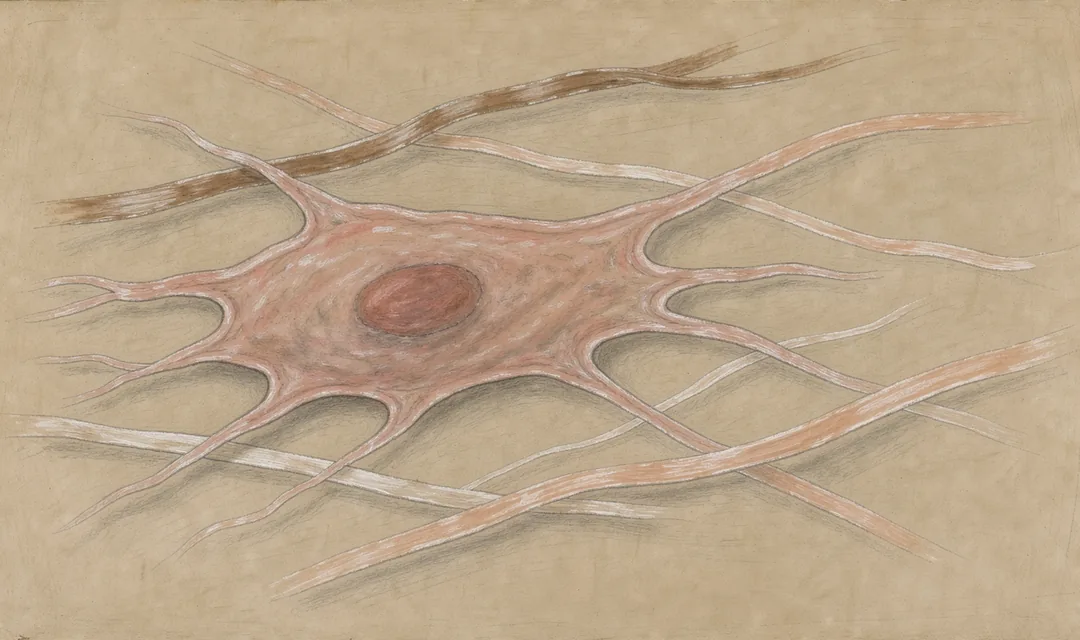
Cultured fibroblasts making collagen
Cell number stayed steady while collagen synthesis rose. That particular separation intrigues me.
Production without proliferation
In the human fibroblast culture experiment, GHK-Cu stimulated collagen synthesis independently of any change in cell number. Stimulation began between 10⁻¹² and 10⁻¹¹ M and reached its maximum at 10⁻⁹ M. Those concentrations describe the culture experiment, with the complex added to the medium.
The unchanged cell number deserves a pencil mark. Proliferation means an increase in cells; synthesis describes what cells make. Here, the investigators reported a specific metabolic response in the cultures. That distinction makes the finding easier to imagine and gives the mechanism a proper subject.
Its economical question suits my fondness for particulars. The experiment asks whether the copper complex changes collagen production under its stated conditions. It gives a much firmer starting point for a discussion of skin biology than the sweeping language of restored youth.
Other supporting material
Collagen shares the scene. A review of GHK in skin regeneration describes GHK-Cu stimulation of dermatan sulfate, chondroitin sulfate and decorin as well as collagen. Decorin is a proteoglycan associated with tissue’s supporting material.
The collection of responses makes the biology appealingly untidy. Beginning with a retained metal has led me into cells changing several things they produce. The review’s account encourages a broader interest in supporting material, even though the most familiar cosmetic shorthand singles out collagen.
The clinical findings discussed in that review include laxity, clarity, fine lines, wrinkle depth and density. Those provide skin outcomes to examine alongside the synthesis work. Their attraction is more concrete than the suggestion that an ingredient has generally renewed a tissue.
A cell making more material is already doing something worth understanding. The next relationship I want examined is between that activity and the reported skin outcome: whether the preparation reaches the relevant tissue, what changes there and how the visible feature is assessed. The topical GHK review makes the delivery problem an explicit subject. That leaves a productive tension between an interesting cellular response and the practical conditions of studying skin.