The copper depot
The experiment gives copper a location and a measurement window. I want to stay with those particulars before imagining what comes next.
The skin-layer preparation
The skin-layer penetration study examined copper applied as a GHK-Cu tripeptide in human skin outside the body. Its title makes the variable unusually clear: penetration as a function of skin layer. The experimental preparation matters because the reported amounts describe copper moving through, and remaining in, that prepared skin.
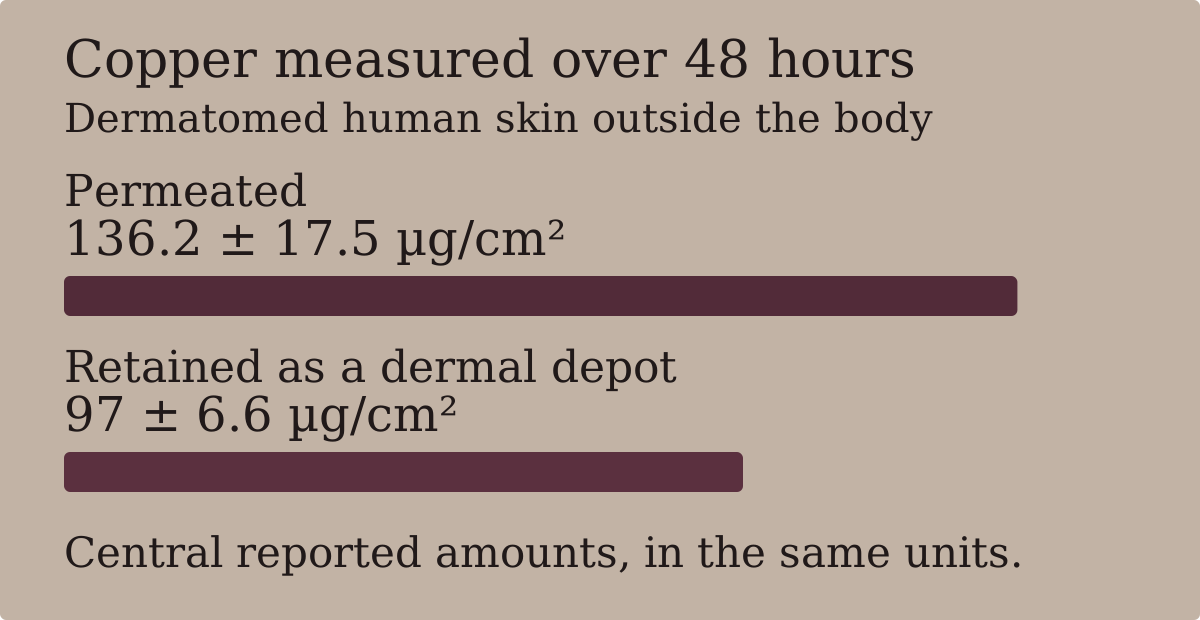
For dermatomed skin, the reported permeability coefficient was 2.43 ± 0.51 × 10⁻⁴ cm/h. Over 48 hours, 136.2 ± 17.5 micrograms per square centimetre of copper permeated, while 97 ± 6.6 micrograms per square centimetre was retained as a dermal depot. These are the study’s copper measurements.
The experiment’s physicality is a pleasure. A broad skincare claim becomes a question about where material can be measured. The skin can be examined as a barrier and as a place of retention, without making the outcome carry a claim about anyone’s appearance.
Permeated and retained copper
The two amounts deserve to sit beside each other. In this laboratory skin experiment, permeation and retention were both reported over the same 48-hour window. The retained amount is the feature that gives the afterimage its subject.
The amounts are reported with plus-or-minus values. Turning them into percentages of an applied dose would require the applied amount as a denominator. An unstated denominator would spoil a perfectly tangible comparison.
A dermal depot raises a useful next question: what is the retained copper doing? The measurement of an amount gives that question a location. Answering it would require observations of chemical form and tissue response alongside the copper measurement.
After the measurement window
Forty-eight hours provides a defined observation window. The next sample would tempt my curiosity: the amount still present, its form, and whether the tissue continues to respond. For a claim about persistence, my patience extends as far as the measurements. The penetration paper gives the present essay its measured trace.
A later review of topical GHK treats poor passage through the outer skin barrier as a central delivery challenge and discusses ways of improving it. I read the depot result alongside that problem. Getting more material into or through skin is an experimental achievement whose significance depends on the preparation and the outcome being pursued.
The next essay turns from location to activity: collagen synthesis in cultured cells. That change of subject is deliberate. A cell response has to earn its own place beside a measurement of copper.